
How Arrest Warrants Work in Cherokee County
An arrest warrant is a judge's signed order letting law enforcement take someone into custody. Georgia requires probable cause first. That means facts a reasonable person would accept as showing an offense happened and that the named person committed it. The Cherokee County Magistrate Court takes warrant applications from both peace officers and civilians. Its judges also hold first appearances and set bail soon after a booking. Warrants can be signed outside normal counter hours, and the court runs a continuous operation for core judicial work, with after-hours judges identified on call. That matters for anyone checking status. A name missing from a convenience index this morning may still exist in the controlling court or Sheriff system. The signed warrant itself, not a search result, is what authorizes an arrest in Cherokee County.
Cherokee County Probable Cause Review
Filing an application is not the same as getting a warrant. A Cherokee County magistrate judge reviews the sworn facts and decides whether probable cause exists. Applications from law enforcement may hold investigative material kept closed while an inquiry runs. Civilian applications follow the Magistrate Court process and guarantee nothing. The official Magistrate Court jurisdiction page confirms the court issues arrest and search warrants, though it is not a name-search database. For the bigger picture, Superior Court handles felony trials after charging, and State Court handles misdemeanors. The court tied to the case is always the key holder of the record.
Key distinction: a sworn application asks for judicial action; only a judge's issued order authorizes an arrest.
Arrest Warrants: What They Contain
Cherokee County publishes no public sample warrant that carries personal data. Official forms and workflows still show the typical fields. Expect a case, citation, warrant, or incident number. Dates can be issue, service, court, or update dates, so read each one with its label before drawing any conclusion.
| Issuing authority | Magistrate Court or another authorized judge and court. |
|---|---|
| Record identifier | A case, warrant, citation, or linked incident number. |
| Named subject | Identity details used by the responsible agency, not reproduced here. |
| Underlying event | A general offense or court-process category, subject to access limits. |
| Status and date | Issued, served, recalled, quashed, or another controlling-office term. |
| Bond or release | An amount, bond type, appearance term, or release instruction if set. |
For current status, only the issuing court or the Sheriff's records system can confirm what stands today. A similar name alone proves nothing about identity in Cherokee County.
Cherokee County Arrest Warrant Channels
Route your question to the office that controls that piece of the record. The Sheriff Warrant/Civil Unit, 678-493-4251, processes, serves, and maintains local warrants. Cherokee E-911 also lists 770-345-3309 under "Warrants," and the Sheriff main line is 678-493-4200. Name the county and court when you call, and confirm which line holds the status you need.
- For a Magistrate warrant or first appearance, call 678-493-6431.
- For a State Court misdemeanor, call the criminal and traffic clerk at 678-493-6550.
- For a Superior felony case, use the Clerk of Courts or current criminal calendar clerk.
- For a city matter, contact that municipal court before assuming the county holds it.
- For a formal non-exempt record, use the Sheriff or county records-request channel.
Georgia offers no single statewide warrant search. The state instead points people to the local sheriff with a name, date of birth, and county, which in Cherokee County means starting with the Sheriff.
How Warrants Get Served in Cherokee County
Issuing a warrant and serving it are two different acts. The Cherokee Sheriff Warrant/Civil Unit reports that it processes, serves, and maintains local warrants, helps other counties with service here, places and releases holds, and arranges felony extraditions from out of state. A city police department may act on a city matter too. The county Marshal enforces codes, but that role does not create a second public warrant database. After an arrest, booking, first appearance, bail, and release each stand as separate steps, with magistrate judges handling initial appearance and bail for people booked into the Adult Detention Center. A warrant marked "served" has not been dismissed. It only records that service happened, and the criminal case can continue. One more caution: the Sheriff's materials warn the agency never solicits payment for warrants or fines by phone or automated service. Call a government number taken from an official page, never a callback number inside a threat.
Cherokee County Service by the Numbers
For scale, the Sheriff's annual-report archive offers numbers without naming anyone. The 2024 report covers 286,602 residents across 434 square miles and lists 1,910 warrants served. That counts service events in Cherokee County, not open warrants.
That distinction blocks a common mistake. Completed service cannot be subtracted from an unknown active inventory, and it cannot build a roster. Cherokee County publishes no official public active-warrant roster.
Arrest Warrants, Summonses, and Bench Warrants
These orders do different jobs. An arrest warrant rests on a probable-cause finding. A summons orders a person to appear without taking them into custody first. A bench warrant usually follows a missed court duty. Cherokee County and Georgia public materials favor "bench warrant" and "failure to appear" over capias.
| Feature | Arrest warrant | Summons | Bench warrant |
|---|---|---|---|
| Main command | Take the named person into custody | Appear on a stated date | Take a person into custody after a missed duty |
| Basis | Probable cause | Charge or proceeding | Failure to appear or comply |
| Response | Confirm, obtain counsel, plan surrender and bond | Appear as directed | Ask the issuing court about recall, reset, or appearance |
Skip a summons, and the court may issue a bench warrant. The Cherokee County bench warrant process covers that court-duty path in more detail.
Cherokee County Extradition Questions
Distance does not switch off a Cherokee County arrest warrant. The Sheriff Warrant/Civil Unit handles felony extraditions. It arranges returns from out of state and coordinates with other agencies. Extradition moves a person back to the charging jurisdiction. So a Georgia warrant can still reach you there. Ask a Georgia lawyer first. Ask the responsible office which jurisdiction controls, whether a bond is set, and how a surrender would work. Do not travel to a courthouse or jail on an online index alone. A call cannot promise a non-custodial outcome, and an in-person warrant inquiry in Cherokee County may mean immediate custody.
Cherokee County Arrest Record Access
Wondering whether a warrant exists is different from filing an open-records request. The Sheriff records page points to Cherokee County's NextRequest portal for that paperwork. Georgia's Open Records Act, O.C.G.A. §§ 50-18-70 through 50-18-77, presumes records are open unless an exemption applies. The office may then cite an exemption, redact details, estimate fees, or say it holds nothing responsive. The official NextRequest FAQ lays out the account, inspection, response, and fee steps.
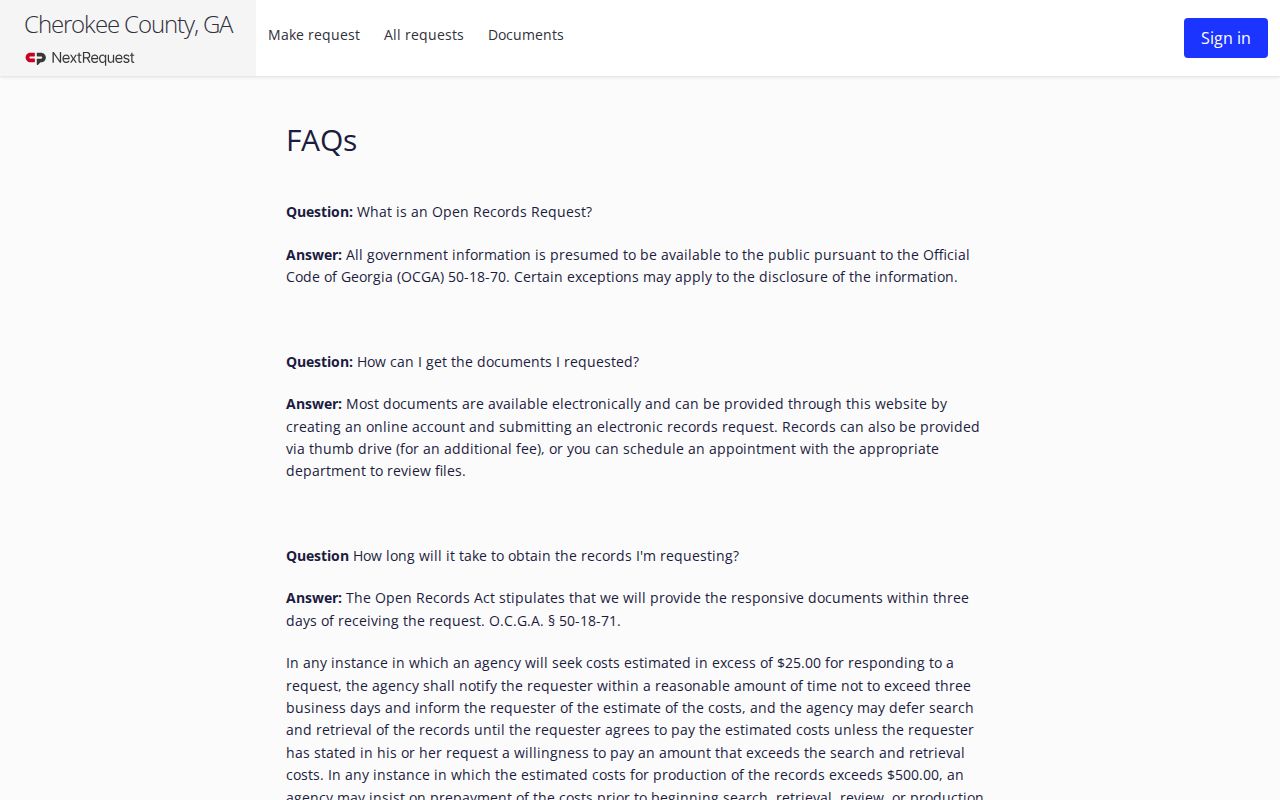
That formal route yields records, not instant warrant status. Sealed, juvenile, protected, and active investigative files in Cherokee County can stay restricted.
Handling an Arrest Warrant in Your Name
First confirm it with the issuing court and Sheriff. Write down the details. Note the case number, court, current status, bond instruction, and the office that answered. Then talk to a lawyer. Counsel can weigh a planned surrender, an authorized bond, a court appearance, or a motion to recall or quash the warrant. Recall means the court withdraws it. Quash means the court sets it aside. A bond in Cherokee County secures appearance; it is not a fine. The Sheriff lists cash, card, professional, and qualifying property bond paths, each with its own terms and fees. Paying does not dismiss the charge, so get a written receipt or order and confirm the connected systems have updated.
Act carefully: speak with counsel before appearing in person because confirmation of an active arrest warrant can result in immediate custody.