
Cherokee County Warrant Searches
Cherokee County posts no searchable warrant roster. The closest county channel is the Sheriff's Warrant/Civil Unit, which lists 678-493-4251. The county's E-911 directory separately shows 770-345-3309 labeled “Warrants.” Neither office explains the split. Ask what each line can confirm before sharing details. Have the full legal name ready, plus date of birth, the likely issuing court, any case or citation number, and the rough date. Georgia's public guidance warns that some sheriffs require an in-person visit with government identification. That matters because confirmation can lead to immediate custody. Checking a warrant in your own name? Talk with a Georgia lawyer before you walk in.
- Identify the issuing court from a citation, notice, prior case, or agency contact.
- Call Sheriff Warrant/Civil at 678-493-4251 for a county service or status question. Ask whether 770-345-3309 is the better line for the record.
- Call Magistrate Court at 678-493-6431 for its warrant and first-appearance workflow, or the State Court criminal and traffic clerk at 678-493-6550 when that court is named.
- For city citations, contact the issuing municipal court. Georgia has no centralized public traffic or warrant search that replaces the local court.
- Use the Clerk of Courts case index or a narrow open-records request for public documents, then obtain direct court or sheriff confirmation of current status.
Cherokee Warrant Phone Routes
Those two Cherokee County numbers carry a lesson. A label like “Warrants” is not a promise about scope. When you call, state your reason, ask which court issued the warrant, and get the date the status was last checked. Never ask an emergency dispatcher to interpret a court file.
Sheriff Warrant/Civil Unit
County warrant service and related status routing.
678-493-4251
Magistrate Court Clerk
Lower-court warrants, applications, and first-appearance routing.
678-493-6431
State Court Clerk
Misdemeanor and traffic case questions.
678-493-6550
Writing down the Cherokee County date, office, staff instructions, and case number makes any follow-up call far more useful.
What a Warrant Search Asks For
Cherokee County publishes no warrant form of its own. The table lists the identifiers official Georgia guidance and local court routes use to narrow a request. Have those details ready before you call. Never send payment details or a Social Security number up front.
| Field Label | Type | Required | Notes |
|---|---|---|---|
| Full legal name | Text | Usually | Include middle name or suffix when known. |
| Date of birth | Date | Often | Helps separate people with similar names. |
| Case or citation number | Text | No | Use the exact number from court papers. |
| Issuing court | Jurisdiction | No | Distinguishes county, city, and federal matters. |
| Approximate date | Date range | No | Helps a clerk locate the right file. |
Cherokee Case Search Limits
The Clerk of Courts case-management search indexes Superior and State Court cases in Cherokee County. It is not a live warrant-clearance tool. A case entry can still show the court, case number, charge, or filing history. A blank result can mean several things. The matter may sit in a municipal court, the warrant may be new or sealed, the investigation may be unfiled, or the index may simply lag. Treat the index as a routing aid. Once the court is known, call its clerk and ask whether a warrant is active, served, recalled, or quashed. “Recalled” or “quashed” means the court withdrew the warrant. Dismissal of a charge is a separate event. Note: A case-search result does not authorize skipping a court date or surrender instruction.
Cherokee County Warrant Search Results
A confirmed answer may list some of these fields. Cherokee County publishes no local warrant-number format, so the sample stays generic. Quote the real number exactly when you follow up. Bond is a financial promise to return to court, not a fine and not proof the case has ended.
| Warrant or case number | An office identifier, such as CASE-NUMBER; no Cherokee format was verified. |
|---|---|
| Charge or allegation | The cited offense or reason connected to the process, subject to access limits. |
| Issuing court | The court with authority to confirm and change the status. |
| Bond | A court-set release term, if one is available and public. |
| Status | Active, served, recalled, quashed, or another office-specific term. |
Georgia Has No Public Hub
Georgia's official guidance names no public statewide warrant database. A local sheriff may insist on an in-person request with government identification. Keep that in mind for Cherokee County. A clean Cherokee County result does not rule out a warrant from another Georgia county or one of its city courts. Federal matters sit on a separate track entirely. Filed dockets may appear through PACER and the Northern District of Georgia, yet a docket search is not a real-time federal warrant check. For a personal federal concern, lean on counsel or the responsible federal court. A county phone line will not hold that answer.
Before visiting: Ask whether identification is required and whether confirmation could result in immediate custody.
Cherokee County Warrants: Who Holds What
In Cherokee County, Magistrate Court takes warrant applications, issues many lower-court warrants, and runs first appearances and bail. Superior Court handles felonies. State Court covers county misdemeanors and traffic cases. Patty Baker, Clerk of Courts, keeps the Superior and State case records. Magistrate and municipal clerks keep their own files. The Sheriff's Office serves county warrants and manages jail and hold information. City courts in Woodstock, Canton, Holly Springs, Ball Ground, and Nelson handle their own ordinance and traffic matters. A city citation goes to that city first. Federal cases go to federal sources. The Sheriff's annual-report archive lists 1,910 warrants served in 2024, one year of activity rather than a count of warrants still active today.
Open Records as a Fallback
When you need a defined public document, the Cherokee County NextRequest guidance explains how to request it, and each agency custodian takes its own requests. This route suits an incident report or an identifiable case record. It will not replace an urgent status call. Broad requests can take longer. Lawful redactions may apply. The county's account and inspection guidance covers response times and fees. Describe the record, the date range, the agency, the court, and any known number. The Sheriff's records page is another agency-specific route. Use the District Attorney or Solicitor-General channel only for records those offices hold.
Which Warrants Stay Restricted
Georgia's Open Records Act, O.C.G.A. § 50-18-70 et seq., opens many agency files, yet not every warrant is public. Sealed filings stay closed. So do juvenile records, confidential personal data, and material tied to a pending investigation, which an agency may withhold or redact. Cherokee County court records also answer to judicial access rules, not to any blanket assumption that each page is open. Some warrant records simply stay restricted.
Key Rules:
Sealed and unserved investigative material may not appear in public search results.
Juvenile files are confidential and require special authority for access.
Absence from an index, GIS page, jail list, or city payment portal is not proof that no warrant exists.
The GIS Warrant Map Trap
A URL can fool a hurried reader. Cherokee County's official GIS service named "Warrants" sounds like a name-search tool, but it is nothing of the sort. It is a geographic warrant-zone map. It shows service geography across mapped zones and takes no person's name, so it cannot establish current warrant status for anyone. Treat it as a map, not a warrant lookup. For the legal record, use the court, the sheriff, and the records custodian instead. A source title alone proves nothing; the fields and the stated purpose have to match the question you are actually asking, or you will read the map wrong.
Cherokee Official Source Views
The Magistrate Court page documents continuous judicial operations and its warrant role.
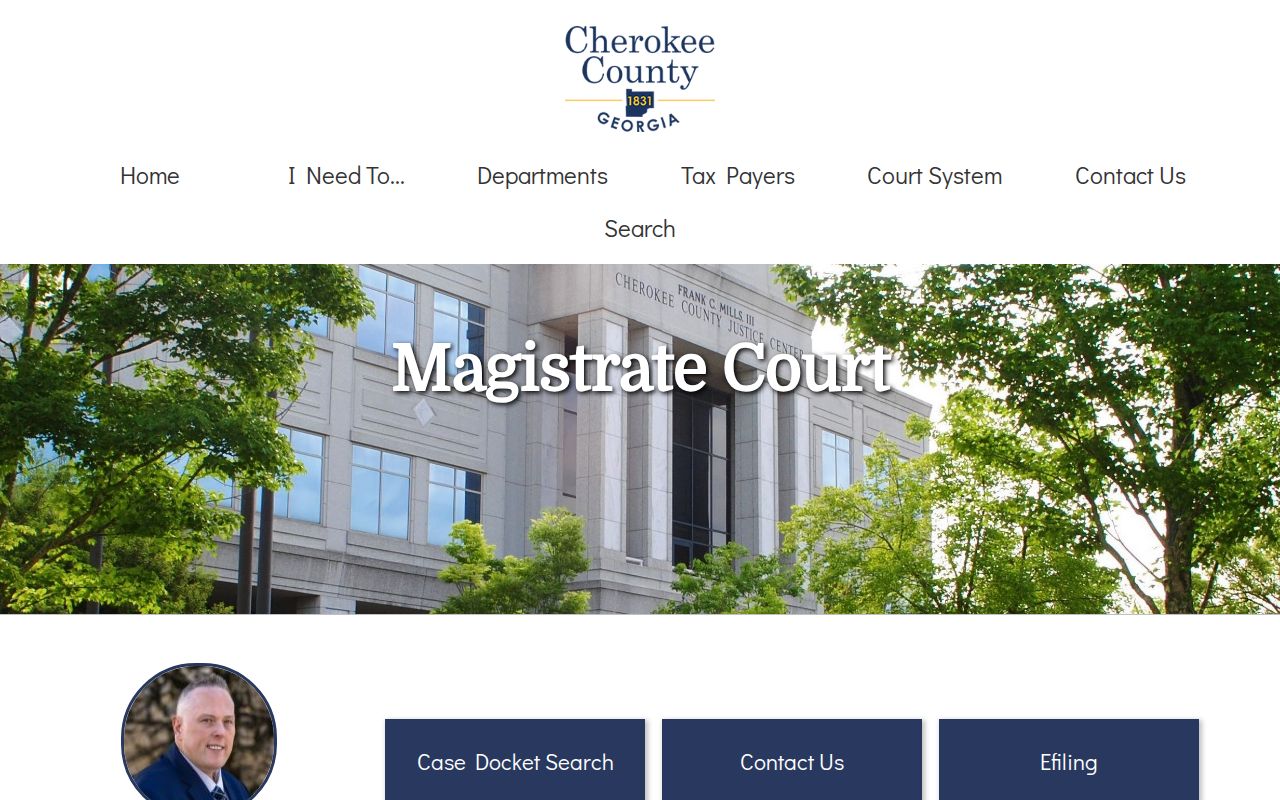
That page supports calling the Magistrate clerk in Cherokee County for a lower-court warrant question rather than trusting a generic web search. The Sheriff's annual-report archive adds public operational context.
Annual service totals describe workload, not a live inventory or a list of people. For the separately labeled warrant number in Cherokee County, the E-911 official directory is the source.
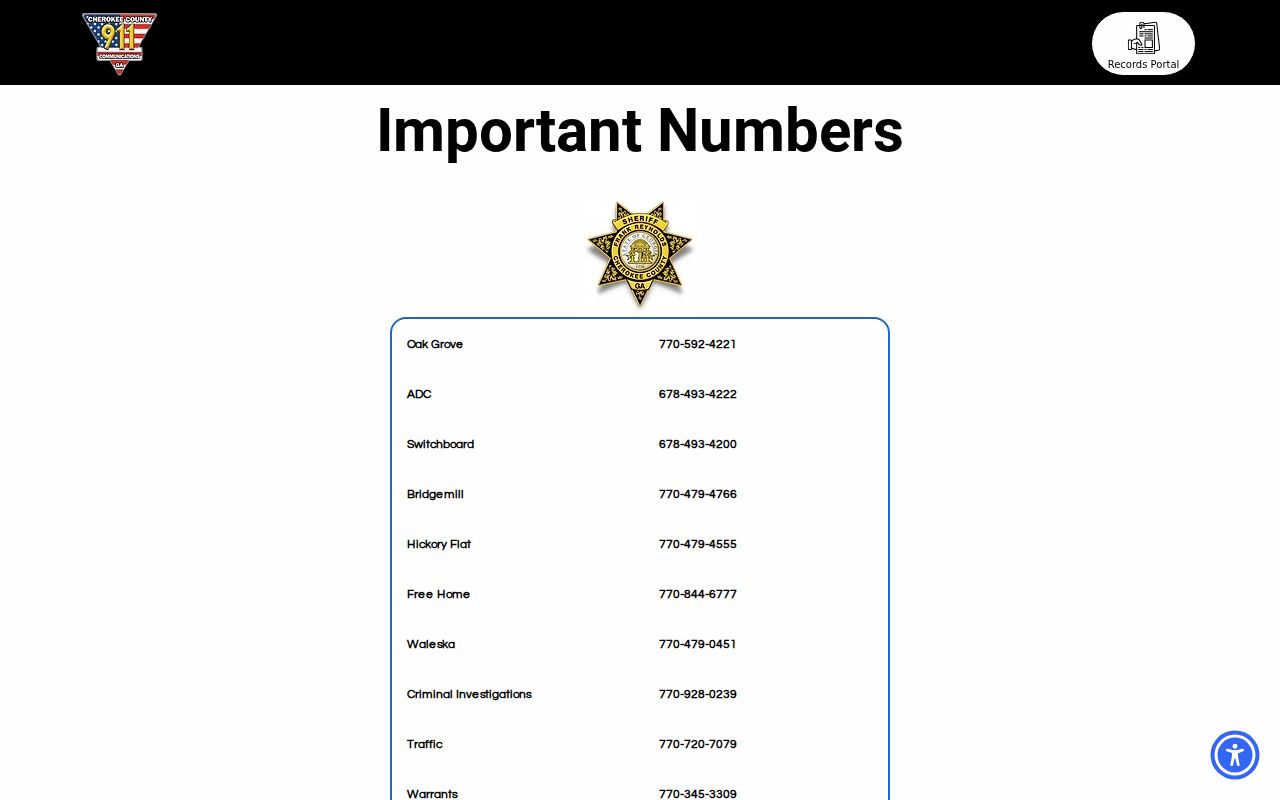
The directory does not explain its relationship to Sheriff Warrant/Civil, so callers in Cherokee County should verify the scope first. The Magistrate Court's contact page identifies the Justice Center and the clerk route.
Confirm your destination before you travel in Cherokee County. The Justice Center and the Adult Detention Center are different facilities.